
Combi oven
Frequently the single largest item and the one with the strongest resale market. Loose, identifiable and in demand, which makes it the best security in most fit-outs.
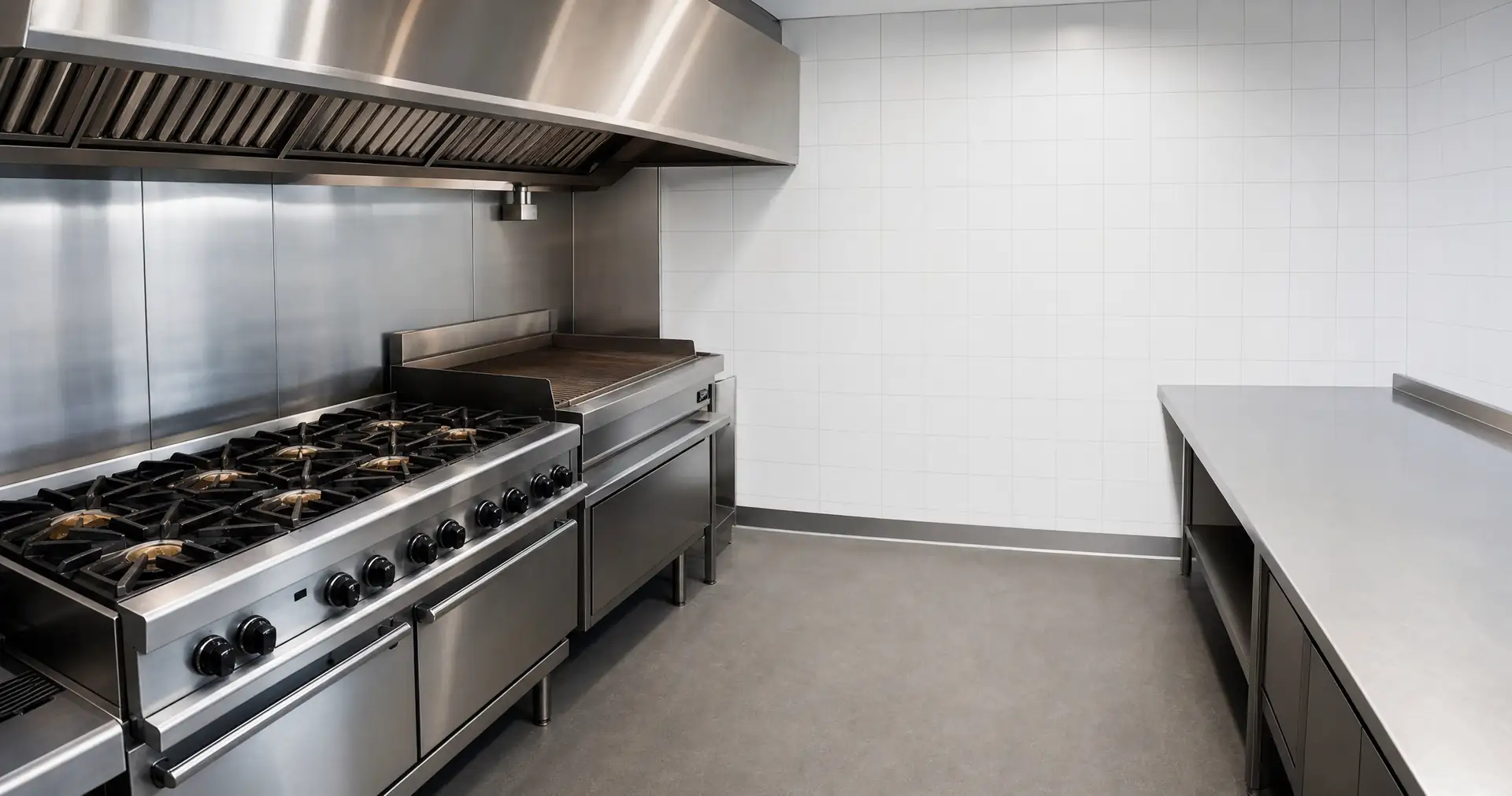
A commercial kitchen is the only purchase on this site where a business is financing thirty machines at once, and where the length of the premises lease matters more than the age of any of them.
Last reviewed 7 September 2026
Indicative repayment
Weekly
$577/week
Indicative only. Not a quote or offer of credit. Actual rates, fees, and repayments depend on the business profile and the lender's decision.
Sending to Prospa
4 years at 12.00% . Prospa will ask a few quick questions, then provide a firm quote and funding if eligible.
Redirecting…
The short version
What it is
Commercial kitchen finance is a secured facility over identified equipment, with the lender registering a security interest on the Personal Property Securities Register. The difference from the rest of this site is arithmetic rather than legal. Instead of one machine on one schedule, a kitchen fit-out is twenty to forty items, and the facility lists them all.
That has a practical consequence worth understanding. Some of those items are loose equipment that can be unbolted, wheeled out and resold, which is the security a lender is actually relying on. Others are built into the premises, and a stainless bench welded into a corner or an extraction canopy tied into a building service is worth very little once removed. Lenders assess a fit-out by asking what share of it is genuinely recoverable, and a fit-out weighted toward joinery and installation rather than toward equipment commonly attracts a deposit for that reason.
The other complication is that most New Zealand hospitality businesses lease their premises. Equipment installed into a leased space is exposed to the lease. Where the lease runs three years and the finance runs five, the lender is being asked to accept two years of exposure to a business that may no longer have a kitchen to operate. Answering that question honestly at the outset produces better outcomes than discovering it in the credit assessment.
Items in a typical fit-out
20 to 40
Indicative rate band
10% to 18% p.a.
Loose equipment share
Commonly 50% to 70%
Registered on
PPSR
By item
Indicative New Zealand purchase bands, illustrative only. Brand, capacity, gas against electric, new against used and the complexity of the installation all move these considerably. A supplier quote decides an actual fit-out.
Frequently the single largest item and the one with the strongest resale market. Loose, identifiable and in demand, which makes it the best security in most fit-outs.
Gas or induction. Gas installation carries certification requirements that sit outside the finance and are worth quoting separately.
High-wear items with a shorter working life than most of the kitchen. Commonly replaced mid-lease and re-financed separately when they are.
Pass-through or conveyor. A machine with steady demand and a reliable used market, which lenders are comfortable with.
Under-bench, upright and walk-in. Walk-in rooms are built into the premises and are treated more like joinery than like equipment.
Canopy, ducting and fan. Largely unrecoverable once installed, and the part of a fit-out lenders discount most heavily.
Made to measure for the space. Very little resale value away from the room it was built for, though essential to the kitchen working.
Mixers, slicers, food processors, gastronorm and utensils. Individually small, collectively significant, and commonly financed inside the same facility.
The common case
The lease question
This is the single most common problem in hospitality equipment finance and it is entirely avoidable. A fit-out financed over five years in premises leased for three, with no right of renewal, leaves two years of payments on equipment installed somewhere the business may no longer occupy. Lenders respond by shortening the term, seeking a deposit, or asking for a guarantee. The version of this that goes well involves knowing the lease term and any renewal rights before the equipment is quoted, so the finance can be structured to fit them rather than the other way around.
Indicative bands
Indicative bands only, and not an offer of credit. Unusually for this site, the term available is driven as much by the premises as by the equipment.
| Situation | Typical maximum term | Deposit commonly sought | Notes |
|---|---|---|---|
| Owner-occupied premises | 60 months | 0% to 10% | The straightforward case. Terms follow the equipment rather than the tenancy. |
| Lease longer than the finance term | 48 to 60 months | 0% to 15% | Also straightforward. Renewal rights in writing are what matter, not an expectation of renewal. |
| Lease shorter than the finance term | 24 to 36 months | 15% to 25% | The common case. Terms are commonly capped near the lease expiry rather than at the equipment’s life. |
| Fit-out weighted to joinery and installation | 36 months | 20% or more | Where most of the spend cannot be recovered, the lender is effectively lending unsecured against part of it. |
| New business, no trading history | Case by case | Often 30%+ | Personal guarantees are close to universal here, and some lenders decline start-up fit-outs entirely. |
Indicative New Zealand market bands for kitchen fit-out finance. Illustrative, not an offer.
The alternatives
Operators prioritising a new kitchen built to their menu typically finance. Operators prioritising a lower entry cost typically take over premises already fitted. The right answer follows the concept and the site.
| Feature | Hire purchase | Operating lease | Buy used equipment | Take a fitted site |
|---|---|---|---|---|
| Who owns it | The business | The lessor | The business | Usually the landlord |
| Upfront cash | Deposit | First month | Full price | Key money or premium |
| Fit to the menu | Exact | Exact | Compromised | Whatever is there |
| Exposure to the lease | High | Lower, equipment returns | High | None on the equipment |
| Servicing | The business | Sometimes included | The business | Usually the business |
| Fits when | The lease is long and the menu is set | The site is uncertain | Cash is tight and the menu is flexible | Speed to opening matters most |
Taking over a fitted site is frequently the cheapest way into hospitality and the least flexible. The kitchen dictates the menu rather than the other way round, and that constraint is worth pricing honestly against the saving.
The process
Written as an observation of what commonly happens rather than as instructions. Every lender differs, and none of this is a guarantee of an outcome.
01
1 to 3 weeks depending on the designer
A single itemised supplier quote covering equipment, installation and delivery is what opens the file. Where equipment comes from several suppliers, lenders commonly still write one facility but want all the quotes together, because the schedule of goods is what the security attaches to.
Documents commonly required
02
3 to 10 working days
Trading history matters as everywhere, and here the lease sits beside it. Term, renewal rights, make-good obligations and whether the landlord has any interest in the fit-out are all things a lender asks about, because they decide what happens to the security if the tenancy ends.
Documents commonly required
03
Within the assessment window
Lenders separate loose equipment from installed work. A combi oven, a dishwasher and under-bench refrigeration are recoverable. Extraction, walk-in rooms and made-to-measure benching largely are not. The proportion drives the deposit more than the total value does.
Documents commonly required
04
Aligned to the fit-out programme
Settlement is frequently staged on a fit-out, because equipment arrives across weeks rather than on one day. The financier commonly pays suppliers directly against invoices and registers its security interest on the PPSR. The first payment usually falls a month after the final delivery rather than the first.
Documents commonly required
A food control plan is required before a commercial kitchen can operate, and extraction and gas installations carry their own certification. Those are operating requirements rather than finance ones, and they have their own timelines that are worth aligning with the fit-out programme.
Worked scenarios
Illustrative scenarios on stated assumptions. The figures are indicative and are produced by the calculator on this page rather than quoted by any lender.
New site, six-year lease with a right of renewal
The operator is fitting out a 45-seat cafe and the itemised quote comes to $118,000 plus GST, of which roughly $70,000 is loose equipment and the balance is benching, extraction and installation.
On these assumptions a 60-month facility at an indicative 12% carries a repayment near $700 a week. The six-year lease sits comfortably behind the five-year term, which is what makes this the straightforward version of a fit-out application. In this scenario no deposit is sought because the recoverable share is high and the tenancy is secure.
Indicative figures
Established operator, three-year lease, no renewal right
An established operator is opening a second site and the fit-out is quoted at $165,000 plus GST. The lease runs three years with no right of renewal, which the operator had not expected to matter.
In this scenario the lender caps the term near the lease expiry rather than at five years, which raises the weekly figure considerably. The operator’s options are to negotiate a renewal right into the lease before signing, to accept the shorter term, or to reduce the fit-out and buy some equipment used. All three are real, and the first is usually the cheapest.
Indicative figures
Two years trading, first fixed site
The operator has a trading history from a food truck and is taking a small fixed site. The fit-out is modest at $58,000 plus GST, weighted toward loose equipment because the site already has extraction.
The existing trading history is what makes this application work despite the business being new to fixed premises. In this scenario a personal guarantee is sought, which is close to universal in hospitality lending, and the high loose-equipment share keeps the deposit at the lower end. The existing extraction is worth more to the finance than it looks, because it is the least recoverable part of any fit-out and it is already there.
Indicative figures
If it goes wrong
Hospitality has a higher rate of business failure than most sectors this site covers, and the recovery position on a fit-out is weaker than on mobile plant. Set out here as fact rather than as a warning.
The financier registered its interest on the PPSR at settlement and has a defined statutory route to take possession under the Personal Property Securities Act 1999. In practice it recovers the loose equipment, because the installed work cannot be removed economically.
What happens:The kitchen is stripped of the equipment that made it work.
Only part of a fit-out is recoverable, and used hospitality equipment sells at a substantial discount into a market with plenty of supply. The difference between what is realised and the balance owing commonly remains payable by the business and by any guarantor.
What happens:A residual debt survives, typically larger than the equipment’s share of the fit-out.
Hospitality fit-out finance is very commonly guaranteed by a director personally, which is a separate obligation surviving the company’s position. Where the borrowing is a sole trader’s and is wholly or predominantly for personal use, the Credit Contracts and Consumer Finance Act can also apply, which is a narrower case but not an impossible one.
What happens:Recovery can extend to the guarantor personally.
Hospitality trading is seasonal and weather-exposed in much of New Zealand. Lenders familiar with the sector are commonly willing to discuss restructuring where a quiet period is raised before arrears build.
Honest assessment
The market
Editorial only. These are the kinds of lender active in this class, listed to describe the market rather than to recommend any of them. We hold no relationship with the lenders named here.
Best for most fit-outs
Non-bank financiers who write hospitality equipment regularly and understand the lease question. The most common source of fit-out finance in New Zealand, at an indicative rate above bank pricing.
Best for established multi-site operators
Typically the sharpest indicative pricing, and more comfortable with an operator who has a track record across sites than with a first fit-out.
Best for single large items
Combi oven and refrigeration suppliers frequently arrange finance on their own equipment. Convenient for one machine, and it fragments a fit-out into several agreements where used for the whole thing.
Best for uncertain sites
Operating leases on hospitality equipment exist and suit an operator who wants the equipment to go back rather than to own it, which matters most where the tenancy is uncertain.
Names are deliberately generic. A comparison of specific lenders would need current pricing we cannot substantiate, and publishing it would be a claim rather than information.
Test the maths
Pre-filled with a mid-size cafe fit-out over four years. The figure that matters is what the kitchen has to turn over each week to carry it. Indicative only, and not a quote or offer of credit.
Indicative repayment
Weekly
$577/week
Indicative only. Not a quote or offer of credit. Actual rates, fees, and repayments depend on the business profile and the lender's decision.
Sending to Prospa
4 years at 12.00% . Prospa will ask a few quick questions, then provide a firm quote and funding if eligible.
Redirecting…
References
The published source for the food safety requirement referred to on this page.
The register on which a security interest over fit-out equipment is recorded.
The statutory basis for the enforcement position set out in the default section.
The published source for the GST treatment referred to on this page.
The published source for the depreciation treatment referred to on this page.
Backs the reference to gas installation certification sitting outside the finance agreement.
FAQ
It covers the fit-out as a whole rather than a single machine, typically twenty to forty items from the combi oven and range through to refrigeration, dishwashing, benching, extraction and smallwares. Lenders normally write it as one facility against an itemised schedule, with a security interest registered on the Personal Property Securities Register.
Because equipment installed into leased premises is exposed to the tenancy. A five-year facility behind a three-year lease with no renewal right leaves two years of payments on a kitchen the business may no longer occupy. Lenders respond by shortening the term, seeking a deposit or asking for a guarantee, so the lease term is worth establishing before the equipment is quoted.
Fit-outs commonly run from $40,000 for a small cafe to $250,000 or more for a full restaurant kitchen. The figures on this page are indicative bands rather than quotes. The split between loose equipment and installed work varies enormously between sites, and that split matters more to the finance than the total does.
Because it is the security the lender is actually relying on. A combi oven, a dishwasher and under-bench refrigeration can be unbolted and resold. Extraction, walk-in rooms and made-to-measure benching largely cannot. A fit-out weighted toward installation means the lender is effectively unsecured on part of it, which shows up as a deposit.
It is harder and it happens. A personal guarantee is close to universal, a deposit is commonly sought, and some lenders decline start-up fit-outs entirely. A trading history in any hospitality format, including a food truck or a catering business, materially improves the position even where the fixed site is new.
It is a genuine option, particularly where cash is tight and the menu is flexible. The trade is that used hospitality equipment has no warranty, service history is often unavailable, and the finance available against it is shorter and more expensive. Buying the reliable items new and the peripheral items used is a common middle path.
Under a hire purchase, a GST-registered business is generally able to claim the GST on the full purchase price in the return covering the period the agreement begins rather than spreading it across the payments, subject to the accountant’s confirmation of the accounting basis used. Under an operating lease the GST is typically claimed on each rental as it is invoiced, again subject to the accountant’s confirmation.
It depends entirely on the lease. Some leases treat fixtures installed by the tenant as the landlord’s at the end of the term, some require the premises to be reinstated, and some are silent. This interacts directly with a financier’s security, so it is one of the clauses a lender reads and one a solicitor is the right person to advise on.
Settlement on a fit-out is frequently staged. The financier commonly pays suppliers directly against invoices as equipment is delivered, and the first repayment usually falls a month after final delivery rather than after the first item. That timing is worth confirming, because it affects cash flow through the fit-out period.
A food control plan is required before a commercial kitchen can operate, gas installations carry certification requirements, extraction systems have their own compliance and cleaning obligations, and grease trap requirements vary by council. All of those are operating costs rather than purchase costs and are budgeted separately from the repayment.
Frequently, and it is also less flexible. A fitted site avoids most of the capital cost and opens faster, at the price of a kitchen designed for somebody else’s menu. Whether that constraint is acceptable is a concept question rather than a finance one, and it is worth answering before comparing the numbers.
The financier recovers what can be economically removed, which is the loose equipment rather than the installed work. That equipment is sold into a market with plenty of supply, so it commonly realises well below its cost, and the difference between the proceeds and the balance owing typically remains payable by the business and by any guarantor.
Related
Refrigeration and cool store finance
The part of a kitchen that carries the stock, and how it is financed.
Read onIT and technology finance
Point of sale and back-office systems, financed on shorter terms.
Read onHospitality equipment finance
How New Zealand cafes, restaurants and bars approach equipment as a sector.
Read onWhat equipment lenders assess
Why the lease sits beside the trading history in this class.
Read onNew against used equipment finance
The trade on used hospitality equipment, set out honestly.
Read onAll equipment finance guides
Every machine class covered on this site.
Read onDisclaimer
Financing a machine is a commitment that runs for years, and the repayments come out of the same operating cash flow as everything else. Modelling the weekly and monthly cost against the working-capital position before committing is what this site is built for. Borrowing at a level that stays comfortable through a quiet quarter, rather than only through a strong one, is widely regarded as the safer frame.
What this site is
A calculator and information tool. Not a lender, not a broker, not a registered financial adviser. Nothing here is personalised financial advice.
What the figures show
Modelled estimates based on the inputs shown. Not a quote. Not an offer of credit. Not a guarantee of approval, rate or fees.
What the lender decides
Final rates, fees, and approval are set by the lender after a CCCFA-appropriate assessment of the applicant's circumstances and credit decision.
Commercial disclosure
Equipmentfinance.org.nz earns a commission from Prospa when a visitor applies through this site and their application is approved. The commission is paid by Prospa, not by the borrower, and it does not influence the rate Prospa offers. Full disclosure on the partner page.
Tax, GST, and accountant framing
Tax-treatment statements (GST claim timing, interest deductibility, depreciation rates) are general in nature and subject to the accountant's confirmation on the specific business position. For material amounts, professional advice from a registered financial adviser or chartered accountant is widely regarded as the safer frame.